
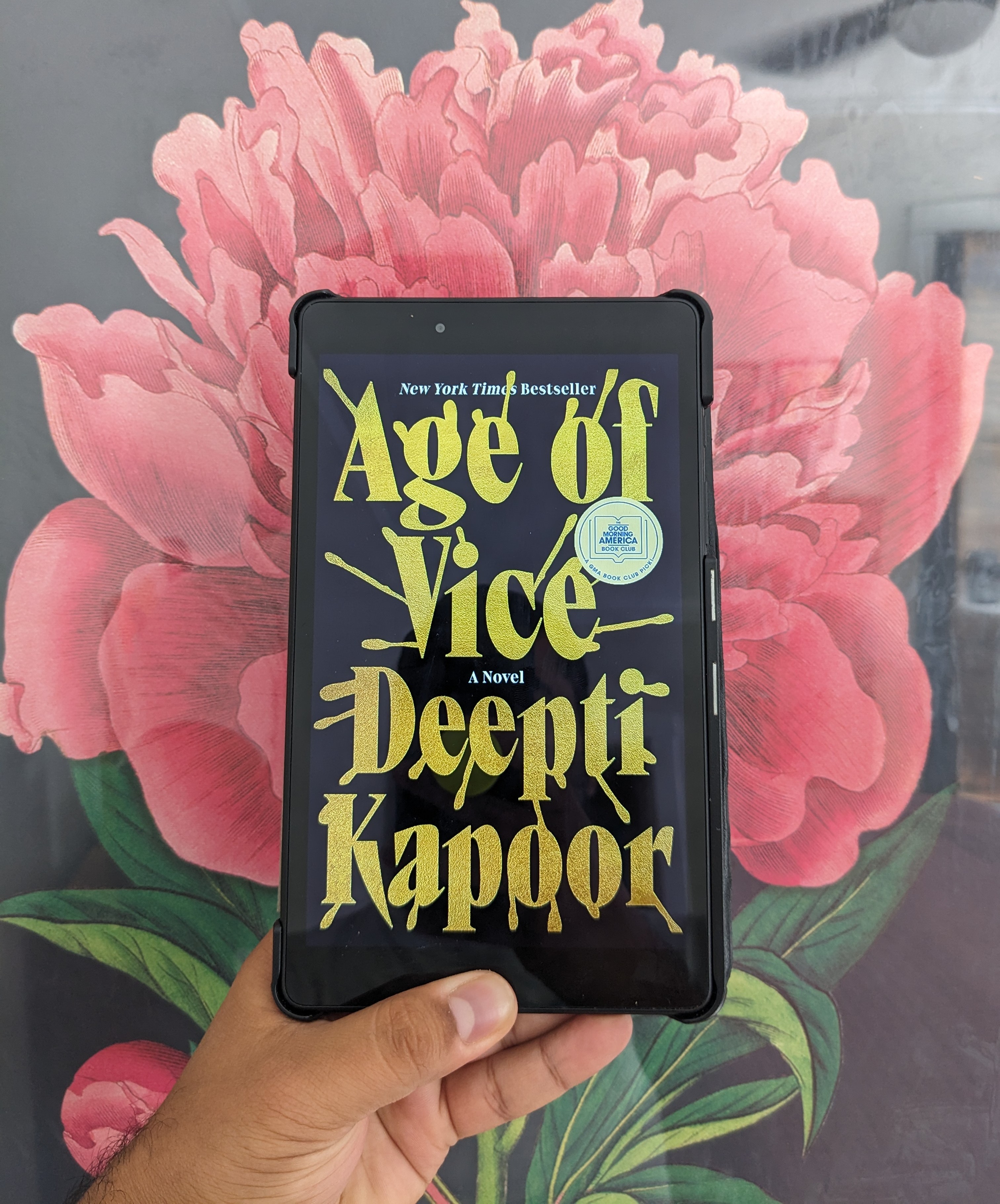
Age of Vice is a novel that decides from the very first page what kind of story it wants to tell. The opening pages detail a horrific traffic incident involving a Mercedes jumping the curb and killing five sleeping unhoused people on the streets of New Delhi. One of these sleepers is a pregnant woman who loses her child. This incident is simply one of many that include horrible circumstances leading to extreme violence. As the story progresses, we watch as the unrelenting hands of powerful individuals move people like pieces on a board, their lives nothing but a resource. Or an obstacle.
We primarily follow three major characters: Sunny Wadia, the son of a powerful gangster, his servant Ajay, and Sunny’s love interest, a journalist named Neda. We follow their rise and fall in the 1990s and early 2000s in India. There is crime, there is corruption, there is slavery, sexual violence, and a lot of blood. This book doesn’t shy away from the violence of this period of time, but revels in it. This is a powerful novel, even if it doesn’t quite stick the landing.
I found myself immediately drawn into Ajay’s story. The horrible circumstances of his upbringing, the remarkable cruelty he suffers as he’s sold into slavery, and the brief childhood he is allowed to have are all heavily Dickensian elements. I wanted to follow this young boy through adulthood. Ajay’s story takes up a good portion of the novel’s beginning, but we don’t get to stay with him for very long.
In part two, we switch to another character, Neda, who made minor appearances in Ajay’s story. This part of the novel was a drag. Though I found Neda interesting as a character, I felt the pacing suffered greatly. If there is a slog to get through, it’s here.
We then switch to Sunny’s perspective. I will give Kapoor props for trying to balance Sunny’s awfulness with empathy, but it didn’t quite ring true for me. I found myself very skeptical of his character, and didn’t feel anything for him other than contempt. Maybe that was the point, but if so, did we need to spend so much time in his head?
Ajay’s storyline makes brief appearances within these shifting perspectives, and I welcomed those with relief. Throughout the entire novel, Ajay was really the only character worth rooting for. Every other character is either irredeemably evil or lacking any sympathetic qualities, which made it hard for me to care about their fates.
Unfortunately, the ending of the novel wasn’t any better. Kapoor decides to introduce a new character 80% into the story with a tediously long chapter on his origin story. She then lets the ending crumble into incoherence. After spending the entire novel showing and telling us everything in beautiful detail, the author decides to create a chaotic, perspective-shifting sequence that’s light on details and heavy on implication. By the final page, I simply didn’t care anymore.
This is solidly a 2-star book for me, but I’ve bumped it up half a star because of the writing. Seriously, reading Kapoor’s descriptions of India feels like reading an epic fantasy novel at times.
This review is also available on my Medium page.
 The Night Bulletin