
Check this post out on Substack.
This is a story I really recommend you listen to before you read any further. I listened to this story several years ago, and it hasn’t left my brain since. When it invades my brain, I stop in my tracks, shudder, and look around like I’m being followed before continuing on my way.

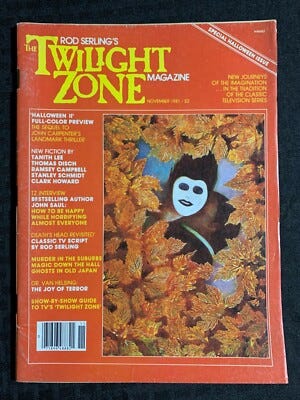
Ramsey Campbell is a horror fiction powerhouse. He’s been writing for decades and has a large body of work (almost 40 novels and hundreds of short stories). This story, “Again,” was first published published in Rod Serling’s The Twilight Zone Magazine in November 1981.
Summary (spoilers ahead)
This story concerns Bryant, a man on a hiking trail. He isn’t too impressed with it. It’s hot out and the flies are relentless. He goes off trail, deeper into the park, where he encounters a run down bungalow. A pale old woman is outside, her eyes pleading. She needs help getting into the house. An odor of strong perfume wafts off of her, bent and frail as she is.
Bryant gets into the house through the kitchen window. He gets stuck in the small opening, and the woman has to push him inside. The kitchen is filthy and smells awful. Bryant isn’t sure if the house is abandoned, or if he’s being rude by assuming an old woman should be able to keep a perfect house.
The house is “senile with dust.” Flies swirl everywhere. He accidentally topples a stack of magazines. When he examines them, he sees that they’re bondage porn magazines. Despite the amount of dust on them, and despite the woman’s age outside, the magazine issues are recent. He happens to look up and finds the old woman staring in at him through the window. He drops the magazines, not liking the look on her face.
Thoroughly uneasy, Bryant tries the front door. Stuck. He then looks for a key, thinking that he can throw it outside and the old woman can unlock the door herself. He wants out of this strange house. He hears a persistent groan somewhere deep in the house. He isn’t sure what it could be.
His politeness keeps him from addressing the obvious: that something is deeply wrong with this house and the woman outside. He finds a gallery wall of wedding photos in the hallway, though each photograph contains a different groom. In another room he finds lewd pictures of the woman and one of these grooms. Again, the woman catches him staring at these obscene items.
Inevitability, Bryant finds a bedroom with a man groaning and writhing under the covers. He sees a can of expired meat on the nightstand, showing how long it’s been since the man was attended to. He rips the covers off and sees not a writhing man, but a corpse covered in writhing flies. Through his horror he notices that the corpse is covered in bites that look recent.
The corpse moves, reaching out to Bryant. He escapes into the hallway just as he hears the woman enter the front door with the key she always had. She’s waiting for him in the living room, naked, corpse-like, and covered in flies. She gives chase, relishing Bryant’s terror. He stabs her with a broken milk bottle, but she leans into the attack, pleasure on her face as she’s gutted.
The woman collapses from the attack, but stirs and rises just as Bryant retrieves the key she dropped. He escapes the house but sees the woman through the window as he flees, mouthing a single word over and over.
You can probably guess what that word is.
Here’s What I Think
This story is a lot, I know. For the squeamish, it’s perhaps the descriptions of the state of the house, the hygiene of the people who occupy this house, and the sexual depravity woven within that will cause the greatest response in the reader. For others, the idea that you can help with the best of intentions and have that kindness exploited for ill intent is the mark of horror.
For me, it’s both of the above ideas, plus one more: the idea that there were others before Bryant, others who fell into this same trap and maybe weren’t so lucky. We don’t know what happened to these people, nor will we ever find out. It’s an unsolvable mystery, like trying to figure out the names of everyone who died in an ancient battle.
The final word, “again,” re-contextualizes the entire piece. It made me stop and think again about what this woman might be. I’m not so sure she’s human. Not anymore. If so, what could she be? A zombie? If so, why hasn’t her hunger driven her out of her home and towards where the food is? The fact the we can’t know what she is, not really, drives home another bit of horror for me: that of the unknowable. The unsolvable.
Ramsey Campbell is a master of setting. He gives you very little, and what he does give you isn’t pleasant. These are places you don’t want to be, even when things seem to be going well (which they often never are in a Campbell story). The setting evokes Thomas Ligotti, another writer whose stories seem to revel in the grotesque and the nihilistic. As Campbell’s Wikipedia article puts it: “His fictional worlds feel unusual, threatening, and dislocated.”
Those three words can describe a lot of horror fiction, but I would argue that a lot of horror fiction these days follows the example of some high fantasy stories: everything must be explained to such a degree as to avoid any criticism of how the world functions. People were tired of stories not outright telling them what was happening, so they rebelled and swung too hard the other way. Now a lot of readers require everything to be told to them. Not every reader, of course, but a lot of mainstream fiction over-explains and under-delivers. Writers like Campbell do the opposite.
So do yourself a favor: if you liked this story, or if it sounds interesting to you, pick up a collection of Ramsey Campbell stories (or one of his novels) and feel unusual, threatened, and dislocated.
 The Night Bulletin